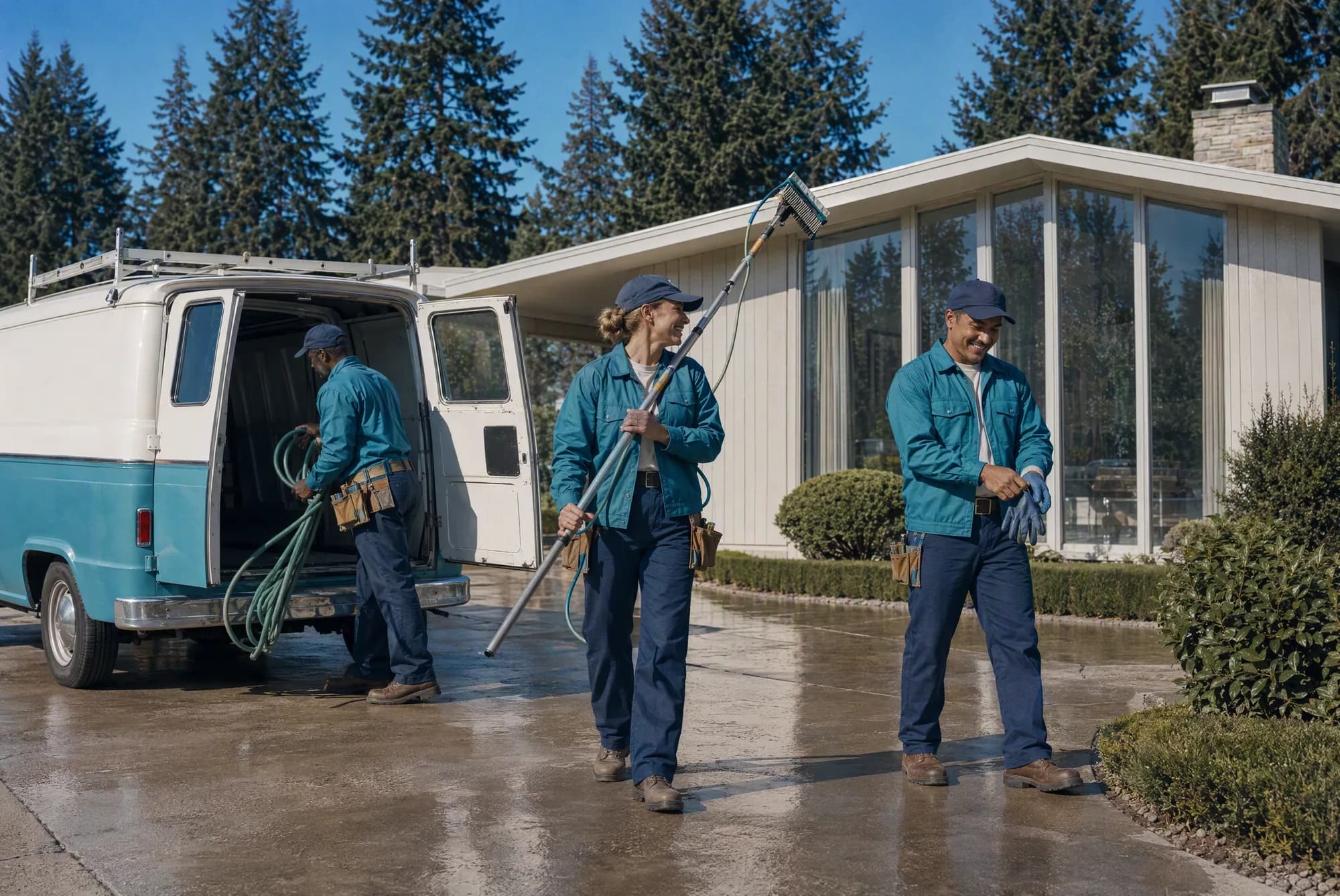
Clean the route the property owner will walk, in the order they'll walk it: the parking spaces nearest the door, the sidewalk, the entrance, then the walls and windows they see on the way in. Have it done the week before, not the day before, so nothing is wet on the morning of the walkthrough and there's time to fix anything that got missed.
That's the short version. Here's the longer one, from the people who clean the outside of commercial buildings around Portland for a living.
Where does the owner look first?
Picture the walk from the car to the front door, because that's the walkthrough. What gets noticed is whatever is underfoot or at eye level along the way. Oil in the spaces closest to the building. Gum flattened into the concrete by the entrance. A green strip along the shady side of the walkway. Dark streaks on the north wall. Water spots on the glass doors.
None of it happened last week. It built up slowly. The people who walk past it every day stopped seeing it months ago. An owner who visits twice a year sees all of it at once.
Can't the porter just hose it down the day before?
For loose dirt, yes, and it's a sensible plan. A hose or a blower moves leaves, litter and dust, and the entrance looks better while it's wet.
The trouble is what a hose leaves behind. Oil, grease and gum hold on to concrete, and cold water runs right over them. Once the concrete dries, usually by the morning of the walkthrough, the spots are back where they were. Gum is patient. It has outlasted every rainstorm Portland has had this year.
In the fall there's a second problem. A walkway that's still damp in the morning is slick, and if it's shaded, it's probably growing algae too.
What should be cleaned first?
In walking order:
- The entrance and the walkway to it. This is where gum, spilled coffee and tracked-in grime collect, and it's the part the owner is standing on when the door opens. We clean concrete with hot water, over 200°F, run through a surface cleaner. That's a round machine with spinning nozzles inside a hood, and it cleans evenly instead of leaving stripes.
- The sidewalk out front. In Portland, the sidewalk in front of a business is the property owner's to maintain, not the city's. We wrote about who cleans the sidewalk if you want the details.
- Shaded concrete. Once the rain comes back, algae and moss grow on the walkways and parking spaces under trees and along the north side of the building. Treating it at the root keeps it gone longer than scraping it off.
- The parking spaces nearest the door. Oil needs heat to let go of concrete, and on heavy spots we put down an eco-friendly degreaser first.
- The walls and windows by the entrance. Walls get a soft wash, which is a cleaning solution put on at low pressure, given time to work, then rinsed gently. High pressure can force water behind siding and strip paint. Windows get pure water, which is water with the minerals filtered out, so it dries without spots. We clean them from the ground with a water-fed pole.
- The trash pad, if the route goes around back. The concrete where the dumpsters sit collects spills and grease, and after a summer it smells. We move the wheeled dumpsters, clean the pad underneath, and clean the outside of the dumpsters too.
If the budget only covers part of the list, start at the top. The entrance is the one surface every visitor stands on.
How far ahead should it be cleaned?
Close enough that it still looks freshly done, and far enough ahead that you can walk the route yourself afterward. The week before works better than the day before. Concrete needs a few hours to dry, and if something got missed, you want time to have it fixed, not a conversation about it at the front door.
If the walkthrough has a date, tell us the date when you call or text. That helps us plan the work around it.
Will the cleaning get in the way of tenants?
We start early and try to be done before the business opens, because nobody wants to step over a hose on the way in. We take photos every visit. You can see the property from your desk, and if the owner asks what was done before the walkthrough, you have pictures to send.
How do we know what the property needs?
We do a free 21-point inspection for commercial properties, HOAs and apartment communities. We walk the property, check 21 points around the outside, and photograph what we find. For each item, the report says what it is, why it matters and how we'd treat it.
We'd like the work, and the report comes with a price for it. Your own crew can also work from it as a checklist. It's yours to keep either way, and it doubles as a list of what to fix before the owner shows up.
You can request an inspection here, or text Rinse It Off at (971) 626-4146.