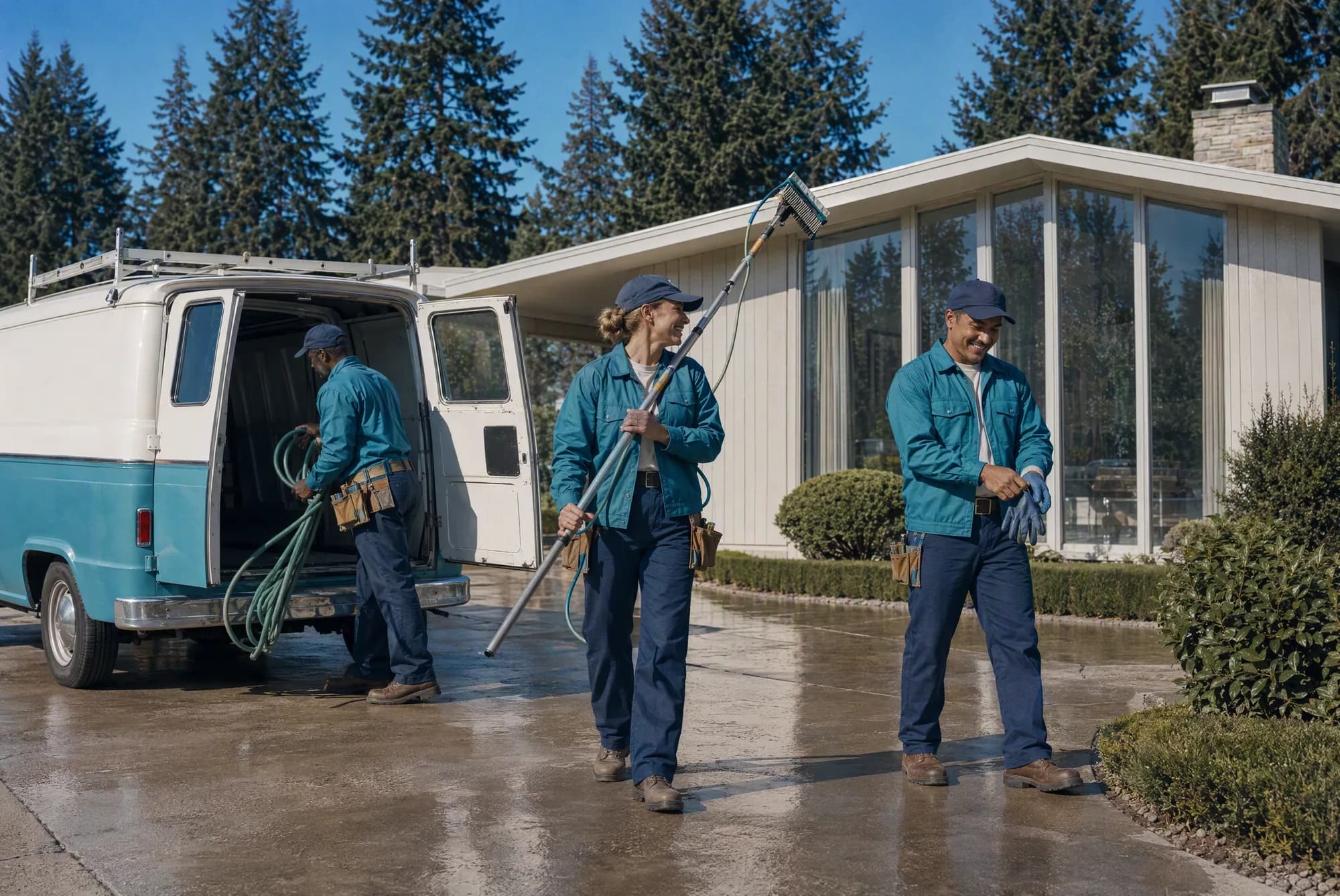
Yes, though most lots don't need it often. A parking lot gets dirty slowly, so it's easy to stop noticing. There are oil spots where the cars park, tire marks where cars turn, gum flattened into the concrete near the entrance, and a green edge along the shady side that wasn't there in August. Every customer and tenant drives across all of it before they get to the door.
Here's what the usual fixes do and don't reach, how we clean a lot, and how often different kinds of lots need it.
Can a hose or a blower do the job?
For loose dirt, yes, and it's a sensible plan. A hose or a blower moves leaves, litter and dust off the lot, and doing that between cleanings helps.
What a hose won't move is the oil. Oil, grease and gum hold on to concrete, and cold water runs right over them. The lot looks cleaner while it's wet, and once it dries the spots are still there. They need heat to let go.
Does the rain clean a parking lot?
In Portland it's a fair question. Rain washes off dust and loose dirt. It doesn't lift oil, for the same reason the hose doesn't.
On the shaded parts of a lot, the rain works against you. Shade from trees and buildings keeps that concrete damp, and once the rain comes back in fall, algae and moss grow on it and it turns slick. That's usually the spaces under the trees and the strip along the north side of the building. People step out of their cars onto both.
Why not use more pressure?
Turning up the pressure on a stain is tempting. It's also how concrete gets etched. We use heat instead.
We clean parking lots with hot water, over 200°F, from a commercial pressure washer, run through a surface cleaner. A surface cleaner is a round machine with spinning nozzles inside a hood. It cleans the concrete evenly, instead of leaving the stripes you get from a wand. On heavy oil and grease, we put down an eco-friendly degreaser first when a spot needs it.
How often does a parking lot need it?
Once or twice a year for most lots, usually in late spring and again before the holidays. Oil spots, tire marks and litter build up slowly, so most lots don't need more than that.
Some lots and some parts of a lot need it more often:
- Drive-through lanes, loading docks and anywhere trucks idle
- Shaded concrete under trees, where algae and moss grow once fall comes
- Lots with heavy traffic, and lots that serve food and coffee
There are also good reasons to clean ahead of schedule: an owner walkthrough, an event, or getting a property ready to lease or sell. We wrote more about how often each part of a commercial property needs washing, from the entrances to the trash pads.
Will it get in the way of the business?
We start early and try to be done before the business opens, because nobody wants to step over a hose on the way in.
We take photos every visit, so you can see the lot from your desk.
How do we know what our lot needs?
We do a free 21-point inspection for commercial properties, HOAs and apartment communities. We walk the property, check 21 points around the outside, including the parking areas, and photograph what we find. For each item, the report says what it is, why it matters and how we'd treat it.
Your own crew can work from it as a checklist, or we can do the work. The report is yours to keep either way. If you want us to do the work, the report includes a price for it.
You can request an inspection here, or text us at (971) 626-4146.